DDS, University at Buffalo School of Dental Medicine (SUNY) · Specialty Certificate in Esthetic Dentistry · Practice founded 2006
Last updated: September 1, 2026
Zygomatic implants are extra-long dental implants that anchor in the cheekbone instead of the upper jaw. They exist for one situation: an upper jaw that has lost too much bone for conventional implants, in a patient who wants fixed teeth rather than a denture. If you have been told you are not a candidate for implants because of bone loss, this is the procedure that sentence was usually leaving out.
This page explains what zygomatic dental implants are, how the surgery is actually done, what the long-term research shows about survival and complications, what recovery looks like, and how they are priced at our Wall Township practice. It is written for the reader who has already been turned away once and is deciding whether a second opinion is worth the drive.
Key takeaways
- They bypass the problem instead of rebuilding it. Zygomatic implants pass through the upper jaw and anchor in the zygoma, a dense bone that does not shrink when teeth are lost.
- No graft, no sinus lift, no waiting. Most zygomatic cases are designed for same-day fixed provisional teeth rather than months of graft healing.
- The evidence is long-term. A systematic review of 4,556 zygomatic implants reported a 12-year cumulative survival rate of 95.21%.
- Complications are real and depend on technique. Sinusitis is the most common; anatomy-guided placement has been associated with lower rates.
- Candidacy is a measurement, not an opinion. Only a CBCT scan can determine it, and ours is included at no charge in a consultation that runs about two hours.
On this page
What are zygomatic implants?
A zygomatic implant is a titanium implant, typically 30 to 50 millimeters long, that enters at the ridge of the upper jaw and anchors its tip in the zygomatic bone — the cheekbone. A conventional implant is 8 to 15 millimeters long and depends entirely on the jaw for stability.
Zygoma: the paired bone that forms the prominence of each cheek and part of the eye socket. It is dense cortical bone, and unlike the alveolar ridge of the upper jaw, it does not resorb after tooth loss. That is the whole reason the technique works.
The technique was introduced by Per-Ingvar Brånemark in 1998, originally for patients who had lost part of the upper jaw to tumor surgery or trauma. Its main indication today is the severely resorbed edentulous maxilla — an upper jaw with no teeth and not enough bone to hold standard implants — and it is also used after failed grafts, failed sinus lifts, and failed conventional implants. In the current treatment guidelines from the Foundation for Oral Rehabilitation, zygomatic implants are described as an evidence-based solution for both two-stage and immediate loading protocols, and today they are usually placed with an immediate loading protocol.
You will sometimes see them called "rescue implants" or "cheekbone implants." They are the same thing. They are also the anchor point for the most advanced form of full-mouth dental implant treatment we offer at Sage Dental NJ, alongside pterygoid, trans-sinus, and trans-nasal implants — the full set of remote-anchorage options for an upper jaw that has run out of bone.
Who zygomatic implants are for
Zygomatic implants are for patients with severe bone loss in the upper jaw who want fixed teeth and cannot be treated predictably with conventional implants or grafting. They are an upper-jaw solution only; the lower jaw has no equivalent structure, and lower-jaw atrophy is handled with grafting or by angling implants into the dense bone at the front of the mandible.
Patients who are commonly evaluated for zygomatic implants share a few histories:
- Long-term denture wearers. A denture presses on the ridge without stimulating it, and after ten or twenty years the upper jaw can be flat enough that standard implants have nothing to hold.
- Patients told "not enough bone" elsewhere. A practice that does not place zygomatic implants will correctly decline the case. That is a statement about the practice, not about your jaw.
- Failed grafts, sinus lifts, or previous implants. Each failed attempt tends to remove more bone, which is why the graftless route becomes more attractive after the first failure.
- Advanced periodontal disease that destroyed the supporting bone before the teeth were lost.
General health matters as much as bone. Well-controlled diabetes, blood-thinner management, smoking status, and active sinus disease all affect whether and how the procedure is planned, and they are reviewed with your medical history at the consultation. None of this can be settled from a description or a panoramic X-ray. A cone beam CT scan measures the remaining ridge, the sinus anatomy, and the thickness and angle of the zygoma on each side — and that scan is what determines candidacy. Nobody, including this page, can tell you whether you are a candidate without it.
How zygomatic implant surgery works
Zygomatic implant surgery is a single procedure, performed under IV sedation, in which the implants are placed and a fixed provisional set of teeth is attached the same day in most cases. Here is the sequence as it runs at our practice:
- CBCT scan and digital planning. The 3D scan maps the maxillary sinus, the ridge, and the zygoma. The path, length, and angle of each implant are planned on that image before anything is touched. Whether an implant runs inside the sinus or along its outer wall is decided from the scan, for each side separately.
- IV sedation by a board-certified MD anesthesiologist. Every full-arch surgery here, including zygomatic cases, is sedated by a physician anesthesiologist rather than the dentist. You are monitored throughout and have no memory of the procedure.
- Extractions, if any teeth remain. Failing teeth are removed at the same appointment. There is no separate extraction visit and no healing period before implant placement.
- Implant placement. The most common configuration is a hybrid arch — one zygomatic implant on each side combined with two to four conventional implants in the front of the jaw, where some bone usually remains. When the front of the jaw is also gone, a quad zygoma arch uses two zygomatic implants per side and no conventional implants at all. Pterygoid implants may be added at the back of the arch when the scan shows usable bone there.
- Same-day provisional teeth. The implants are joined by a fixed provisional bridge fabricated in our on-site dental lab. You leave with teeth that are screwed in, not a denture.
- Final zirconia teeth. After healing, the provisional is replaced with the final prosthesis under the Zirconia ImmediaTEETH® All on X protocol, designed and milled in the same in-house lab by designers trained in fine art and aesthetics.
Two facts from the literature shape how this is done. First, the Foundation for Oral Rehabilitation notes that placement requires adequate training and surgical experience — the anatomy is unforgiving and the margin for error is smaller than with a standard implant. Second, the largest systematic review to date found that studies evaluating immediate loading reported a statistically lower zygomatic implant failure rate than studies using delayed loading, which supports placing and loading the teeth in one surgery rather than waiting.
Zygomatic implants vs. bone grafting vs. sinus lift
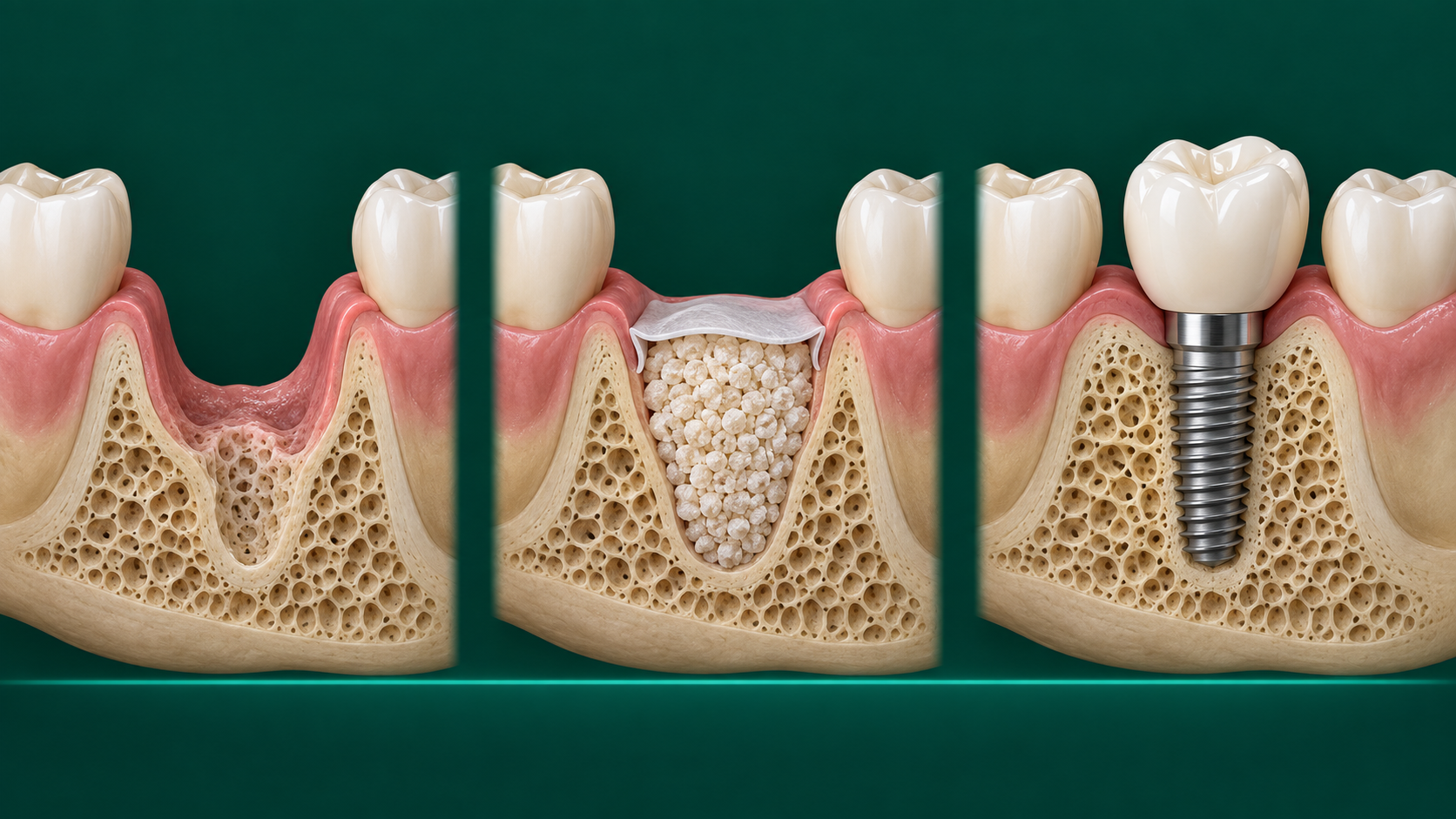
For a severely atrophic upper jaw, the real comparison is not zygomatic implants versus regular implants. It is zygomatic implants versus the combination of grafting, sinus lifts, months of healing, and a second surgery that would be required to make regular implants possible — with no guarantee the graft holds.
| Factor | Zygomatic implants | Bone grafting / ridge augmentation | Sinus lift + delayed implants |
|---|---|---|---|
| What it does | Anchors in the cheekbone, bypassing the resorbed ridge entirely | Rebuilds ridge width or height with graft material and a healing membrane | Raises the sinus membrane and packs graft beneath it to create vertical height |
| Number of surgeries | One (implants and provisional teeth the same day in most cases) | Two or more (graft, then implants after healing) | Two (lift, then implants after healing) |
| Wait before fixed teeth | None in most cases | Commonly 3–6 months of graft healing, then implant healing | Commonly 4–9 months before implants can be placed |
| Depends on the graft healing | No graft involved | Yes — graft failure means starting over | Yes |
| Best suited to | Severe upper-jaw atrophy, failed grafts, long-term denture wearers | Localized deficiencies with enough native bone to support a graft | Upper back jaw where the sinus has dropped but the front jaw is usable |
| Main complication to know about | Sinusitis; soft-tissue recession around the implant | Graft infection or non-integration | Membrane tear; sinusitis |
| Surgical training required | Specific zygomatic training and experience | Standard surgical implant training | Standard surgical implant training |
Healing ranges are typical figures reported across implant literature and vary by patient. Your plan may combine approaches — for example, a zygomatic implant on one side and a conventional implant in grafted bone on the other.
Grafting works, and for a single missing tooth with localized bone loss it is often the simpler choice; we place grafts and perform sinus lifts every week. The point is that for the fully atrophic upper jaw, a graft is a wager on healing that the zygomatic approach does not have to make. If you want the broader picture of every option for a jaw with bone loss, we cover all five approaches in Can You Get Dental Implants With Bone Loss?.
Success rates and complications: what the research shows
Zygomatic implants have a 12-year cumulative survival rate of 95.21% according to the largest systematic review published to date, which analyzed 68 studies covering 4,556 zygomatic implants in 2,161 patients with 103 failures. Most of those failures occurred within the first six months after surgery, which is why early follow-up matters more than late follow-up. A separate systematic review focused on the severely atrophic maxilla reported a cumulative success rate of 96.1% at more than five years.
Those are survival figures across published clinical series, in appropriately selected patients treated by trained surgeons. They are not a promise about any individual case. Implant failure, graft failure, and peri-implant infection are real outcomes in implant dentistry, and a page that writes them out of existence is not one you should trust.
Complication rates by surgical technique
Complications are where technique shows. A 2023 systematic review compared the original surgical technique, which routes the implant through the sinus, with an anatomy-guided approach that follows the contour of the sinus wall. Survival was similar; complication rates were not.
| Complication | Original technique (through the sinus) | Anatomy-guided approach |
|---|---|---|
| Sinusitis | 9.53% | 4.39% |
| Soft tissue infection | 7.50% | 4.35% |
| Paresthesia (altered sensation) | 10.78% | 0.55% |
| Oroantral fistula (sinus-to-mouth opening) | 4.58% | 1.71% |
| Direct surgical complication | 6.91% | 1.60% |
Source: Evaluation of surgical techniques in survival rate and complications of zygomatic implants, International Journal of Implant Dentistry, 2023 (see clinical sources below). Figures are pooled probabilities across the included studies, not the rates of any single practice.
Three practical conclusions follow. Sinusitis is the complication to ask about, and it can appear years after placement, so long-term follow-up is not optional. The path of the implant relative to the sinus — planned from the CBCT, individually for each side — is a major determinant of the risk you take on. And soft-tissue health around the implant needs a specific maintenance routine, because the way a zygomatic implant emerges through the gum is different from a conventional implant and standard periodontal measurements do not apply cleanly.
What recovery from zygomatic implant surgery looks like
Most patients are back to light, everyday activity within a few days and eating a soft diet on their provisional teeth from the first day. Because the surgery bypasses the areas of bone loss rather than rebuilding them, there is no graft site to protect and no months-long wait with no teeth.
- Day of surgery. You go home with fixed provisional teeth, prescribed medication, and written instructions. Someone else drives; IV sedation rules that out for you.
- Days 1–3. Swelling and bruising of the cheeks peak, then begin to settle. Pressure and soreness are expected; sharp pain, fever, or one-sided nasal discharge are not, and should be reported the same day.
- Weeks 1–2. Soft, non-chewy food only. No nose-blowing, no straws, and sneeze with the mouth open — the implants sit close to the sinus and pressure changes matter during early healing.
- Weeks 2–6. Bruising resolves; diet expands gradually as instructed. Follow-up visits check the fit and screws of the provisional and the tissue around each implant.
- Months 3–6. Osseointegration — bone fusing to the implant surface — completes, and the final zirconia teeth are fabricated and delivered.
Long-term maintenance follows a published protocol specific to zygomatic implants: examination of the jaw joint and soft tissues, inspection of the transmucosal path of each implant, peri-implant health indices, examination of the prosthesis for wear or fracture, and photographic records at each recall. That is the standard we use at follow-up rather than a routine hygiene visit.
What zygomatic implants cost in New Jersey
Zygomatic implant cases at Sage Dental NJ are quoted individually and confirmed in writing at the consultation, on top of a published full-arch starting price that most practices will not disclose. Zygomatic cases involve longer implants, more complex planning, and more surgical time than a standard full arch, and the quote reflects the actual case rather than a menu price.
| Item | Price | What it includes |
|---|---|---|
| Consultation | $0 | About two hours, CBCT scan and X-rays at no charge, treatment options and pricing in writing to take home. No referral needed. |
| Full arch, ImmediaTEETH® | From $11,990 per arch | Extractions and bone grafting included; no separate surgical add-on fees. Advanced remote-anchorage procedures, including zygomatic implants, are quoted separately. |
| Full mouth, upper and lower | From $19,990 | All-inclusive for both arches; zygomatic and other remote-anchorage work quoted separately. |
| Copy of your CBCT scan and X-rays | $350 | Only if you want the files for another provider; the scan itself is free. |
Starting prices; individual cases vary with complexity. Every figure is confirmed in writing before you commit to anything.
The honest cost comparison is not against a standard arch. It is against the grafting route: a graft or sinus lift, months of healing, a second surgery, and the possibility of starting over if the graft fails — often with a removable denture in the meantime. Seen that way, the difference is usually smaller than the sticker price suggests.
Zero hidden fees, no upcharges
We are out-of-network with all dental and medical insurance and provide the procedure codes and documentation you need to submit your own claim. Financing is available through multiple third-party lenders, including 0% plans up to 18 months, fixed-rate low-monthly plans, options for applicants with poor or no credit, and plans that allow a co-borrower. HSA and FSA funds are accepted.
See financing optionsWhy patients travel to Wall Township for zygomatic implants
Zygomatic implant surgery is a drive-in decision, not a neighborhood one, because relatively few practices in New Jersey place them and even fewer do the surgery and the final teeth under one roof. Patients come to us from Monmouth and Ocean County — Belmar, Spring Lake, Sea Girt, Manasquan, Brick, Point Pleasant, Neptune, Howell, Freehold, Toms River — and also from Middlesex, Mercer, and Atlantic counties and Staten Island, typically for one of three reasons.
- They were told no. Most of our zygomatic patients arrive with a prior opinion. We review your existing scans if you bring them, and if the case cannot be treated, we say so directly.
- Surgery and teeth in one place. Dr. Israeli places the implants and restores them; the provisional and final teeth are made in our on-site lab. There is no oral surgeon in one town and restorative dentist in another, each waiting on the other.
- A physician does the sedation. Full-arch cases are sedated by a board-certified MD anesthesiologist, which matters to patients whose medical history is part of why they were declined elsewhere.
We are at 1520 Route 138 in Wall Township, off Exit 98 of the Garden State Parkway, with parking on site. Because the surgery is a single appointment and the provisional teeth go in the same day, a longer drive is realistic: you make one trip for the consultation, one for surgery, and follow-up visits are scheduled with the distance in mind.
Frequently asked questions about zygomatic implants
What is the average cost of zygomatic implants?
Zygomatic implant cases cost more than a standard full arch because the implants are longer, the planning is more complex, and the surgical time is greater. At Sage Dental NJ, full-arch treatment starts at $11,990 per arch with extractions and grafting included, and zygomatic cases are quoted individually on top of that, in writing, after the CBCT scan. The consultation and scan are free, so you can get an exact number for your case before spending anything.
How long do zygomatic implants last?
With proper care and maintenance, zygomatic implants can last decades. The largest systematic review reported a 12-year cumulative survival rate of 95.21% across 4,556 implants, with most failures occurring in the first six months rather than later. Long-term success depends on sinus health, soft-tissue maintenance around the implants, and keeping the recall appointments — the same factors that govern conventional implants, with more emphasis on the sinus.
What are the potential downsides of zygomatic implants?
The main risks are sinusitis, soft-tissue infection or recession where the implant emerges through the gum, altered sensation in the cheek, and — less commonly — an opening between the sinus and the mouth called an oroantral fistula. Reported rates vary widely with surgical technique; anatomy-guided placement has been associated with substantially lower complication rates than the original through-the-sinus technique. The procedure also requires specific surgical training, and the anatomy leaves less room for error than a standard implant. These are reasons to choose the surgeon carefully, not reasons to rule the procedure out.
How successful are zygomatic implants?
Published survival rates are high and consistent across reviews: 95.21% cumulative survival at 12 years in the largest systematic review, and 96.1% cumulative success beyond five years in a review focused on the severely atrophic upper jaw. Those figures apply to appropriately selected patients treated by experienced surgeons. Immediate loading — attaching fixed teeth the same day — was associated with lower failure rates than delayed loading in the pooled data.
Can general dentists place zygomatic implants?
In the United States, implant surgery is within the legal scope of a general dentist's license; what matters is specific training and experience with zygomatic anatomy, because the procedure is among the most technically demanding in implant dentistry. Dr. Israeli is a general dentist with a DDS from the University at Buffalo, a Specialty Certificate in Esthetic Dentistry, and continuing education in dental implants and sedation dentistry, and has placed and restored implants in private practice since founding Sage Dental NJ in 2006. Ask any provider — surgeon or dentist — how many zygomatic cases they have completed and who administers the sedation.
Is zygomatic implant surgery painful?
The surgery itself is performed under IV sedation, so you are not aware of it. Afterward, pressure, swelling, and soreness in the cheeks are expected for several days and are managed with prescribed and over-the-counter medication; most patients describe it as less than they feared. Sharp or escalating pain, fever, or one-sided nasal discharge are not normal and should be reported immediately.
I live in Staten Island or Central Jersey. Is it worth the drive for a second opinion?
If you have been told you do not have enough bone for implants, usually yes, because the answer depends on whether the practice you saw offers remote-anchorage implants at all. Our consultation is free, includes the CBCT scan, takes about two hours, and you leave with your options and pricing in writing. Wall Township is off Exit 98 of the Garden State Parkway; bring any existing scans and we will review them the same visit.
Find out whether zygomatic implants are an option for you
A two-hour consultation with Dr. Israeli, a CBCT scan and X-rays at no charge, and your treatment options and pricing in writing before you decide anything. No referral needed. Second opinions welcome.
Schedule your complimentary consultation(732) 528-6007Sage Dental NJ — Dr. Avi Israeli, DDS
1520 Route 138, Wall, NJ 07719
Monday–Wednesday 8:30am–5:00pm · Thursday 10:30am–7:00pm · Friday 8:30am–2:00pm · Saturday & Sunday closed
Sage Dental NJ & NJImplantDOC™ is an independent practice in Wall Township, New Jersey, owned and operated by Dr. Avi Israeli. We are not affiliated with any other dental practice or group operating under the Sage Dental name.
Clinical sources
- Chrcanovic BR, Albrektsson T, Wennerberg A. Survival and Complications of Zygomatic Implants: An Updated Systematic Review. Journal of Oral and Maxillofacial Surgery, 2016.
- Success Rates of Zygomatic Implants for the Rehabilitation of Severely Atrophic Maxilla: A Systematic Review. PubMed Central, 2022.
- Evaluation of surgical techniques in survival rate and complications of zygomatic implants for the rehabilitation of the atrophic edentulous maxilla: a systematic review. International Journal of Implant Dentistry, 2023.
- Zygomatic implants — treatment guidelines. Foundation for Oral Rehabilitation.
- Five Steps for the Maintenance and Interception of Complications in Zygomatic Implants. PubMed Central, 2023.