Reviewed by Dr. Avi Israeli, DDS — Sage Dental NJ, Wall Township. DDS, University at Buffalo School of Dental Medicine; Specialty Certificate in Esthetic Dentistry; practice founded 2006.
Last updated: September 16, 2026
Sage Dental NJ is an independent practice owned by Dr. Israeli. It is not affiliated with the multi-state Sage Dental group.
For one missing tooth with healthy neighbors and enough bone, a dental implant is usually the better long-term choice; for a gap where the neighboring teeth already need crowns, a bridge is often the smarter one. The difference between a dental implant and a bridge is not "good versus cheap." It is where the replacement tooth gets its support: an implant stands on its own titanium root in the jaw, and a bridge borrows support from the teeth on either side of the gap.
This guide lays out what each one is, what the survival data actually shows at ten years, what they cost in New Jersey over twenty years using our published implant pricing, and the specific situations where Dr. Israeli recommends a bridge over an implant at our Wall Township office.
Key takeaways
- An implant replaces the root; a bridge rests on the neighbors. That single fact drives every other difference.
- At ten years, survival is similar (about 89% for both in the largest review), but the failures look different: bridges tend to fail through decay under the anchor crowns.
- Over twenty years the implant usually costs less, because a bridge is typically replaced at least once and each replacement risks the anchor teeth.
- A bridge is the right call when the neighbors already need crowns, when bone is inadequate and grafting is not wanted, or when the result is needed in days.
- There is a third option: a bridge held by implants, which replaces several teeth without touching any natural ones.
In this article
- What is the difference between a dental implant and a bridge?
- Implant vs. bridge at a glance
- How long does each one last?
- Cost in New Jersey: upfront and over 20 years
- When a bridge is the better choice
- When an implant is the better choice
- Front teeth: the esthetic zone changes the math
- The third option: an implant-supported bridge
- Frequently asked questions
What is the difference between a dental implant and a bridge?
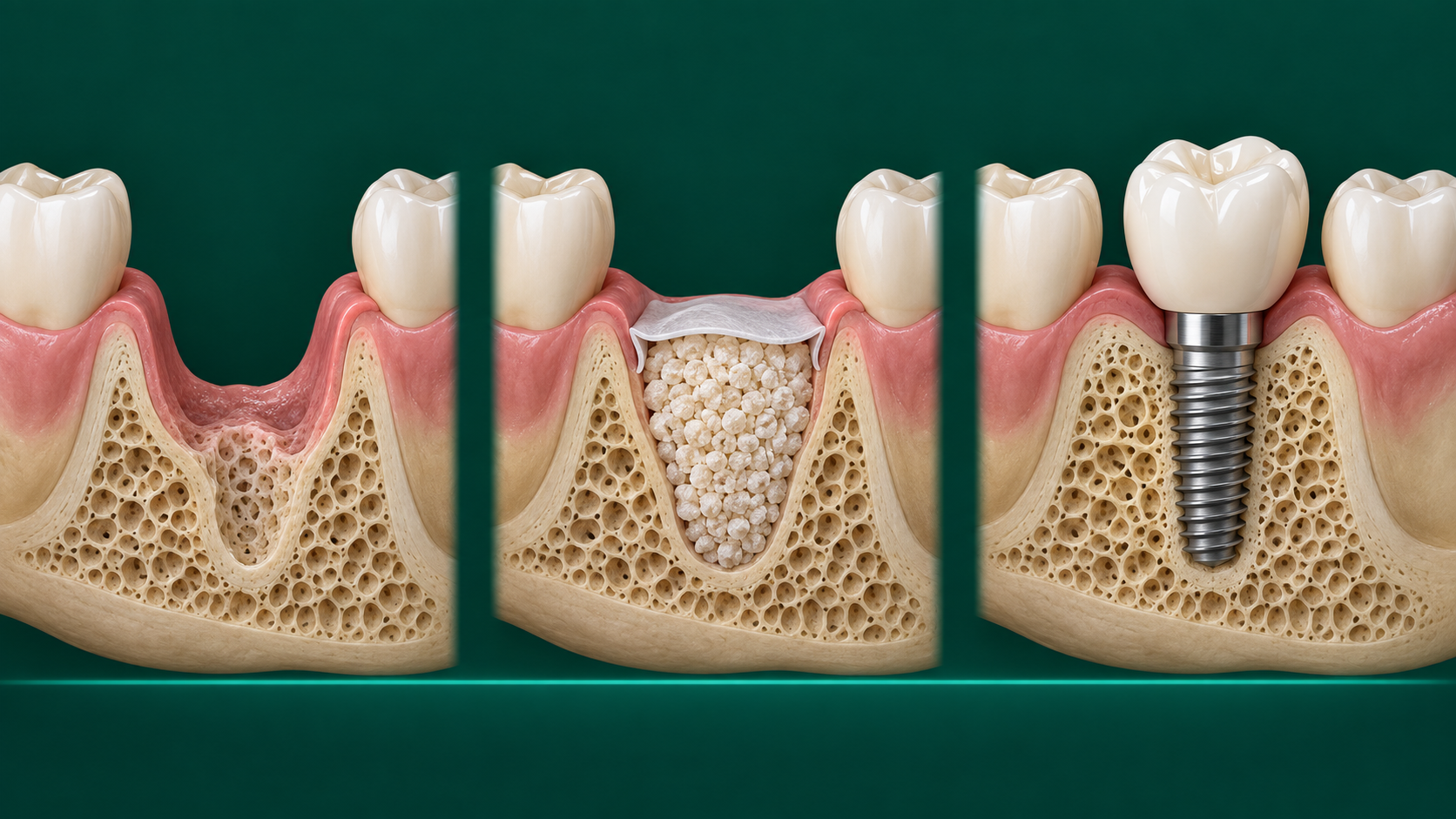
A dental implant replaces the missing tooth root with a titanium post placed in the jawbone, and a crown is attached to that post once the bone has fused to it. A dental bridge replaces the missing tooth with an artificial tooth (a pontic) that is fused to crowns cemented onto the natural teeth on each side of the gap. The implant is independent; the bridge is a three-unit structure that depends on two other teeth.
Dental implant: titanium root in the bone + abutment + crown. Replaces one tooth without touching the neighbors. Healing time of roughly three to six months before the final crown, unless an immediate crown is placed at surgery.
Traditional (tooth-supported) bridge: crown on the left neighbor + artificial tooth + crown on the right neighbor, cemented as one piece. The two neighbors are reshaped by removing enamel so the crowns fit. Usually completed in two visits over two to three weeks; same-day with an in-house lab and CEREC milling.
Implant-supported bridge: the same bridge structure, but the anchor crowns sit on implants rather than natural teeth. Replaces two to four teeth in a row without preparing any natural tooth.
The reshaping step is the part most people underestimate. To seat a traditional bridge, healthy enamel is permanently removed from two teeth that had nothing wrong with them. That is acceptable when those teeth already need crowns, and a real cost when they do not.
Implant vs. bridge at a glance
The table below is the side-by-side most patients ask us to draw on the whiteboard. It compares a single implant with crown to a traditional three-unit bridge replacing one tooth.
| Factor | Single dental implant | Traditional 3-unit bridge |
|---|---|---|
| Support | Titanium root in the jawbone | Crowns on the two neighboring teeth |
| Effect on neighboring teeth | None | Enamel removed from both; they carry the chewing load of three teeth |
| Jawbone at the gap | Stimulated and largely preserved | Not stimulated; slow bone loss under the pontic continues |
| Surgery | Yes, usually under local anesthesia | No |
| Time to final tooth | Typically 3 to 6 months (immediate crown possible in some cases) | 2 to 3 weeks; same day with in-house CEREC milling |
| 10-year survival (systematic review) | About 89% for the crown; about 95% for the implant itself | About 89% for conventional bridges |
| Most common failure | Crown chipping or loosening; less often, peri-implantitis | Decay or nerve death in an anchor tooth, which can take the whole bridge with it |
| Cleaning | Brush and floss like a natural tooth | Floss threader or water flosser under the pontic |
| Insurance (typical) | Often excluded or capped | Often partially covered as a major service |
| Sage Dental NJ price | From $1,995 (implant, abutment, crown) | Quoted at consultation, in writing |
Survival figures are from the Pjetursson et al. systematic review in Clinical Oral Implants Research and a 2022 review in Periodontology 2000; see sources. Sage Dental NJ pricing is current as of the date above and subject to change.
How long does each one last?
At ten years, a conventional tooth-supported bridge and an implant-supported single crown survive at almost the same rate, roughly 89% in the largest comparative systematic review, but they fail for different reasons and with different consequences. The review found the most frequent problems with tooth-supported bridges were biological: decay at the crown margins and loss of pulp vitality in the anchor teeth. Implant crowns more often had technical problems, such as chipping or a loose screw, which are repairable without touching the implant.
Three points from the evidence that matter when you are choosing:
- The implant outlives its crown. Ten-year survival of the implant fixture itself is about 95%; the crown on it is closer to 89%. A worn or chipped crown is replaced on the same implant.
- A bridge failure often means a bigger bridge. When an anchor tooth decays under its crown, it may need a root canal, or be lost, and the replacement bridge then has to span a wider gap on different teeth.
- Cantilever bridges do worse. A bridge anchored on only one side had a ten-year survival of about 80% in the same review.
Claims that implants "last a lifetime" are marketing, not data. With proper care and maintenance implants can last decades, and many do, but the honest comparison is implant plus one or two crown replacements against a bridge plus one or two full bridge replacements over the same span. Our guide to how long dental implants last covers what shortens or extends that.
Cost in New Jersey: upfront and over 20 years
A single dental implant with abutment and crown at Sage Dental NJ starts at $1,995, and the published national range for a traditional three-unit bridge is roughly $1,500 to $5,000. On day one the two options overlap. Over twenty years, they usually do not, because a bridge that lasts ten to fifteen years is replaced at least once, and each replacement carries the cost of the anchor-tooth problems that caused the failure.
| 20-year scenario (one missing back tooth) | Single implant | Traditional bridge |
|---|---|---|
| Initial restoration | $1,995 at Sage Dental NJ (implant, abutment, crown) | $1,500 to $5,000 (published national range) |
| Likely replacement work in 20 years | One replacement crown on the same implant | One replacement bridge, sometimes two |
| Anchor-tooth risk | None | Root canal and post/core on an anchor tooth is common before a bridge is remade; loss of an anchor tooth means a longer bridge or an implant anyway |
| Bone at the site | Preserved; future options stay open | Continues to resorb; a later implant may need grafting |
| Typical insurance behavior | Often excluded or subject to a low annual maximum | Often covered at 50% of a major-service allowance, subject to the same annual maximum |
This is a scenario, not a quote. Your written treatment plan from the consultation is the controlling figure. Sage Dental NJ is out-of-network with all insurance plans and provides procedure codes for self-submission.
Two things change this math. If the neighboring teeth already need crowns, the bridge is effectively three crowns you needed anyway plus a pontic, and it becomes the cheaper option by a wide margin. And if the site needs bone grafting before an implant, add that to the implant column; at Sage Dental NJ a single implant with extraction and grafting is $2,795. The full New Jersey picture is in our cost of dental implants in New Jersey guide, and financing terms are on the financing options page.
When a bridge is the better choice
A bridge is the better choice when the teeth on either side of the gap already need crowns, when there is not enough bone for an implant and the patient does not want grafting, or when the replacement is needed within days rather than months. Dr. Israeli recommends bridges in these situations and does not treat them as a consolation prize.
- The neighbors need crowns anyway. Large old fillings, cracks, or previous root canals on both adjacent teeth mean the enamel reduction costs you nothing you were keeping. This is the most common reason a bridge wins.
- Not enough bone, and no appetite for grafting. A bridge needs no bone at the gap. If the site has resorbed and you would rather not add a grafting step and its healing time, a bridge is a legitimate route.
- A medical reason to avoid surgery right now. Uncontrolled diabetes, a recent cardiac event, or certain osteoporosis medications can make deferring implant surgery the prudent choice; a bridge can be placed in the meantime.
- Speed. With our in-house lab and CEREC milling, a bridge can be designed, milled, and cemented in a single visit. An implant crown is months away.
- Budget is the actual deciding factor this year. A bridge that is partially covered by insurance may be the only option that fits; it can be replaced by an implant later, though the anchor teeth will already have been reshaped.
When an implant is the better choice
An implant is the better choice when the neighboring teeth are healthy, when the gap is at the end of the arch with no tooth behind it, when the patient is younger and the restoration must last several decades, or when two or more teeth in a row are missing. Each of these is a case where a bridge either damages something healthy or cannot be built at all.
- Healthy neighbors. Grinding down two intact teeth to replace one is the trade an implant avoids.
- No tooth behind the gap. A traditional bridge needs an anchor on each side. A last molar with nothing behind it is an implant case, or a cantilever bridge with its lower survival rate.
- Younger patients. A 35-year-old choosing a bridge is signing up for two or three bridge replacements over a lifetime, each one harder on the anchor teeth than the last.
- Multiple missing teeth. Long-span bridges flex and fail sooner; two or three implants supporting a bridge is the more durable design.
- The patient wants to keep future options open. An implant preserves the bone at the site; a bridge lets it resorb, so a later switch to an implant often needs a graft.
The single-implant process, timeline, and what to expect on surgery day are on our dental implants page.
Front teeth: the esthetic zone changes the math
For a missing front tooth, the decision is less about survival percentages and more about how the gum and bone around the replacement will look in five years. This is where Dr. Israeli's Specialty Certificate in Esthetic Dentistry matters more than anywhere else, because both options can look wrong in the front if the soft tissue is not planned.
An implant preserves the bone under the gum, which keeps the gum line level with the neighbors over time; the risk is a visible gray edge or recession if the implant is placed too shallow or too far forward. A bridge can be shaped to make the gum under the pontic look natural on day one; the risk is that as the bone under the pontic slowly resorbs, a dark triangle opens beneath it and the pontic starts to look like it is floating. A resin-bonded (Maryland) bridge, which glues wings to the back of the neighbors without crowning them, is a third front-tooth option that spares the enamel but debonds more often under biting force.
In the front, we design the final tooth in our own lab from photographs and a digital scan, and we match shade and translucency against the adjacent natural teeth rather than a shade guide alone. The smile gallery shows single front-tooth cases done both ways.
The third option: an implant-supported bridge
An implant-supported bridge replaces two to four missing teeth in a row using two or three implants as the anchors, with no natural tooth prepared. It combines the independence of implants with the economy of a bridge: three missing molars can be replaced with two implants and a three-unit bridge rather than three separate implants.
At Sage Dental NJ these are made in monolithic zirconia in our in-house lab, which is the material we use for our zirconia fixed bridges and for full-arch teeth. Zirconia does not have a porcelain veneer layer to chip, which addresses the most common technical complication reported for implant bridges in the literature. Ten-year survival for implant-supported bridges in the comparative review was about 87%, close to the other two options; the advantage is not a higher number but that a failure does not involve a natural tooth.
When the gap is an entire arch, the comparison becomes fixed full-arch implants versus a removable denture, which is a different decision. Our page on fixed versus removable implant teeth covers that one.
Bring the other estimate
If another office has already quoted you a bridge or an implant, bring the plan. The consultation includes a CBCT scan at no charge, so we can see the bone at the site and the condition of the neighboring teeth, and tell you which option the evidence favors in your mouth, in writing.
Schedule a complimentary consultationImplant or bridge? Get the answer in writing
The consultation is complimentary and includes the 3D scan that settles the bone question. You leave with both options priced and a recommendation you can take anywhere.
Included at no charge
- CBCT 3D scan and X-rays of the site
- Assessment of the neighboring teeth
- Both options priced in writing
- Second opinion on any plan from another office
Frequently asked questions
Which is better, a dental bridge or an implant?
For one missing tooth with healthy neighbors and adequate bone, an implant is usually better because it spares the adjacent teeth and preserves bone. When the neighboring teeth already need crowns, or bone is inadequate and grafting is not wanted, a bridge is usually the better choice. Neither is better in every mouth; a CBCT scan and an exam of the adjacent teeth decide it.
How much is a bridge vs. an implant?
At Sage Dental NJ a single implant with abutment and crown starts at $1,995. Traditional three-unit bridges are commonly priced in the $1,500 to $5,000 range nationally; ours is quoted in writing at the consultation. Over twenty years the implant usually costs less because bridges are typically replaced at least once. Prices are subject to change.
Does a bridge or an implant last longer?
At ten years the survival rates are similar, about 89% for both a conventional bridge and an implant crown in the largest comparative review, while the implant fixture itself survives at about 95%. The practical difference is that an implant crown is replaced on the same implant, whereas a failed bridge often means treating or losing an anchor tooth first.
Can I get a bridge now and an implant later?
Yes, though with two costs. The enamel removed from the neighboring teeth for the bridge does not grow back, so those teeth will need crowns permanently, and the bone under the bridge's pontic keeps shrinking, so a later implant at that site may need grafting. If an implant is the eventual plan, placing it sooner usually avoids both.
Is a bridge covered by insurance when an implant is not?
Often, yes. Many dental plans cover a bridge as a major service at around 50% up to the annual maximum, and exclude or cap implants. Sage Dental NJ is out-of-network with all plans; we give you the procedure codes for either treatment so you can submit for whatever reimbursement your plan allows.
What is a Maryland bridge, and is it a good option for a front tooth?
A Maryland (resin-bonded) bridge holds a front replacement tooth with thin wings bonded to the backs of the neighboring teeth, so no crowns are needed. It spares enamel and is quick, but it debonds more often than a conventional bridge under biting force. It is often used as a long-term provisional for younger patients before an implant, or when a patient wants to avoid both surgery and crowns.
Sage Dental NJ (Dr. Avi Israeli, DDS) — independent practice, not affiliated with any other Sage Dental group
1520 Route 138, Wall, NJ 07719
Phone: (732) 528-6007
Mon–Wed 8:30am–5:00pm · Thu 10:30am–7:00pm · Fri 8:30am–2:00pm · Sat–Sun closed
Sources
- Pjetursson BE, Brägger U, Lang NP, Zwahlen M. Comparison of survival and complication rates of tooth-supported fixed dental prostheses (FDPs) and implant-supported FDPs and single crowns (SCs). Clinical Oral Implants Research, 2007. PubMed 17594374
- Prosthetic failures in dental implant therapy. Periodontology 2000, 2022. PMC9305548
- American Dental Association, MouthHealthy. Bridges. mouthhealthy.org
- Cleveland Clinic. Dental bridge vs. implant: which is right for you? health.clevelandclinic.org
- Healthline. Dental implant vs. bridge: pros, cons, and which to choose (national bridge cost range). healthline.com