
Reviewed by Dr. Avi Israeli, DDS — Sage Dental NJ, Wall Township. DDS, University at Buffalo School of Dental Medicine; Specialty Certificate in Esthetic Dentistry; practice founded 2006.
Last updated: September 16, 2026 (originally published 2023; fully revised)
Sage Dental NJ is an independent practice owned by Dr. Israeli. It is not affiliated with the multi-state Sage Dental group.
A bone graft for dental implants adds bone material to a part of the jaw that has thinned or shrunk, so that an implant has enough solid bone to anchor into. Roughly one in four implant cases involves some form of grafting, and the need is decided by a CBCT scan that measures the bone in millimeters, not by how long a tooth has been missing or how the gum looks.
This guide explains the four procedures the word "bone graft" covers, what the graft is actually made of, how long each takes to heal before an implant can go in, what it costs at our Wall Township office, the real benefits and risks, and the cases where Dr. Israeli can skip the graft altogether with a different implant approach.
Key takeaways
- Whether you need a graft is a measurement, not an opinion. The CBCT scan at our complimentary consultation shows the bone width and height at the site.
- "Bone graft" means four different procedures: socket preservation, ridge augmentation, sinus lift, and block grafting. Healing time and cost differ by a wide margin.
- At Sage Dental NJ, grafting is built into the price. A single implant with extraction and bone graft is $2,795; full-arch pricing includes all grafting with no add-on fees.
- Most grafts heal in 3 to 6 months before the implant is placed; a small socket graft at extraction is often the only graft ever needed.
- A graft is not always required. Zygomatic, pterygoid, and angled implants can bypass missing upper-jaw bone and usually deliver teeth the same day.
In this article
- What is a dental bone graft?
- Do you need a bone graft for a dental implant?
- The four types of bone grafting for implants
- What the graft is made of
- How long after a bone graft can you get the implant?
- Dental bone graft cost in New Jersey
- Benefits and risks of bone grafting
- Recovery: what the first two weeks look like
- When you can skip the graft
- Frequently asked questions
What is a dental bone graft?
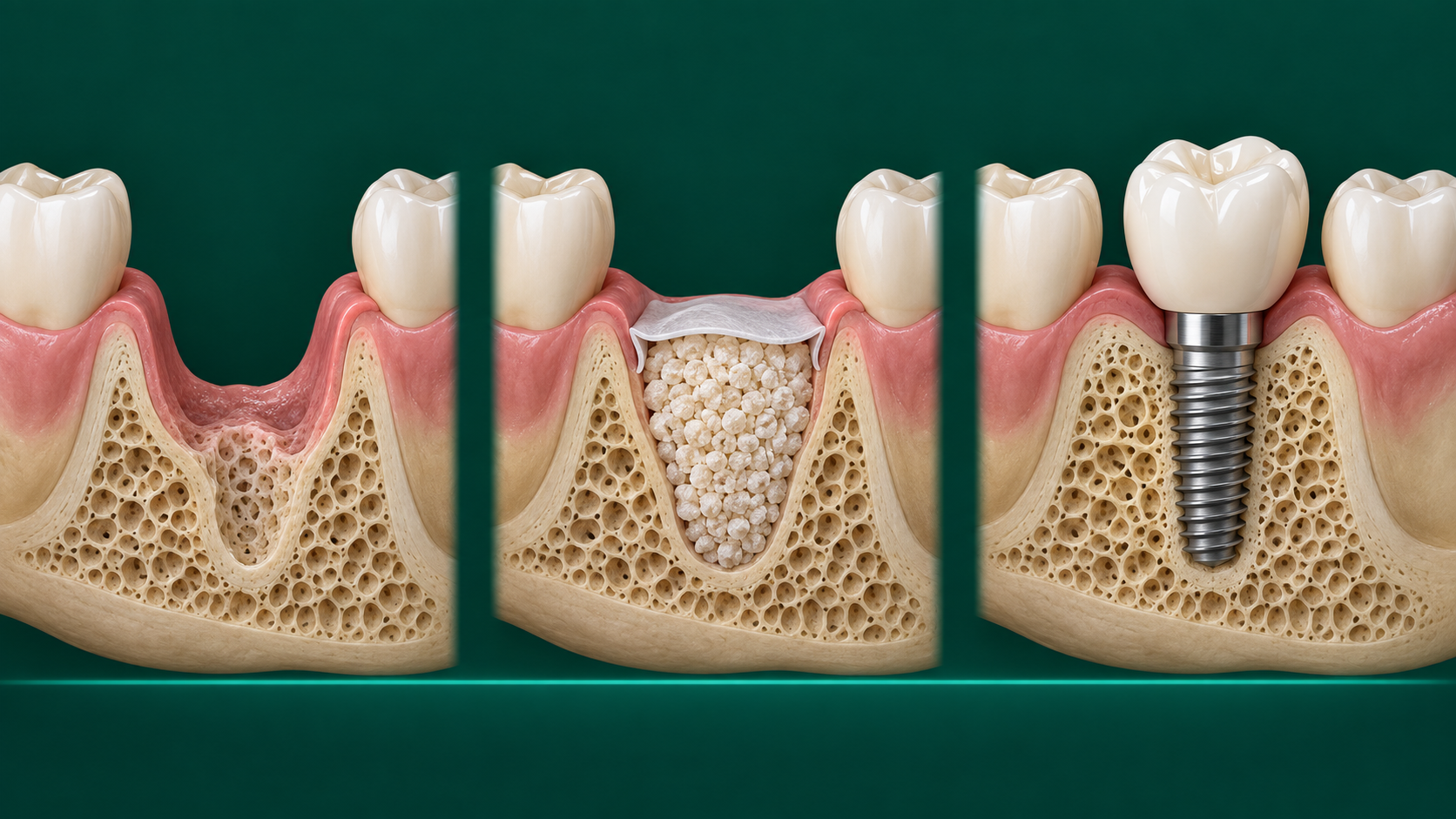
A dental bone graft is a minor surgical procedure in which bone or a bone-like material is placed against or inside the jaw where bone has been lost, then covered and left to heal while your own bone grows through it. The graft is a scaffold. It holds the shape of the missing bone while your body replaces it with living bone over the following months.
Bone is lost from the jaw for one reason above all others: a tooth was removed and nothing replaced its root. The jawbone is maintained by the chewing forces that travel down tooth roots, and once a root is gone the surrounding bone begins to resorb. That loss is irreversible on its own; it continues for as long as the site stays empty, which is why a tooth extracted fifteen years ago often leaves too little bone for a standard implant today. Gum disease, infection, and injury cause the same result faster.
Do you need a bone graft for a dental implant?
You need a bone graft when the CBCT scan shows less bone than a standard implant requires at the site, in width, in height, or in both. As a rule of thumb, a conventional implant wants at least 1 to 1.5 millimeters of solid bone on every side of it and enough height to stay clear of the sinus above or the nerve below. The scan gives those numbers directly; there is no guessing.
The situations that most often produce a "yes":
- A tooth removed years ago with nothing placed in the socket, leaving a narrow ridge
- An upper back tooth where the sinus has expanded downward into the space the root used to occupy
- Advanced gum disease that dissolved bone around the tooth before it was lost
- A tooth being extracted now whose socket walls are thin, especially upper front teeth, where a small graft at the time of extraction prevents the collapse that would otherwise require a larger graft later
- Years in a full denture, which accelerates resorption of the ridge the denture rests on
The consultation at Sage Dental NJ includes the CBCT scan at no charge, and Dr. Israeli goes through the images with you on screen, pointing to the site and the numbers. Patients who bring a scan from another office get the same review of their existing images. Our guide to dental implants with bone loss covers what the scan can and cannot tell you.
The four types of bone grafting for implants
Bone grafting for dental implants is four distinct procedures, and the one you are quoted for should be named specifically, because they differ in invasiveness, healing time, and cost. The table below is the comparison we draw for patients at the consultation.
| Procedure | When it is used | What is done | Typical healing before implant |
|---|---|---|---|
| Socket preservation (alveolar ridge preservation) | At the time a tooth is extracted, when an implant is planned | Graft material is packed into the fresh socket and covered with a collagen membrane | 3 to 4 months; sometimes the implant is placed the same day as the extraction instead |
| Ridge augmentation (guided bone regeneration) | A healed site where the ridge is too narrow or too short | Particulate graft is layered onto the ridge under a membrane, sometimes with tacks or a mesh to hold shape | 4 to 6 months; larger vertical gains take longer |
| Sinus lift (sinus floor augmentation) | Upper back teeth where the sinus sits too low for a standard implant | The sinus membrane is lifted and graft is placed beneath it, through the side of the jaw or through the implant site itself | 4 to 9 months for a lateral-window lift; an implant can often be placed at the same time as a smaller internal lift |
| Block graft (onlay) | Severe loss where a large amount of bone must be rebuilt in one step | A block of bone, from the patient's chin or ramus or from a donor, is screwed to the ridge and later covered with particulate | 4 to 6 months; the most invasive option and the one most often replaced today by zygomatic or pterygoid implants |
Socket preservation deserves the most attention because it prevents the other three. In a meta-analysis of molar extraction sites, grafting the socket at extraction reduced horizontal bone loss by about 2.2 millimeters compared with letting the socket heal on its own, and cut the need for additional grafting at implant placement by more than half. If you are having a tooth removed and might ever want an implant there, a socket graft at extraction is the least expensive decision in this entire article.
What the graft is made of
Dental bone grafts are made from one of four materials: your own bone (autograft), sterilized human donor bone (allograft), processed animal bone, usually bovine (xenograft), or a synthetic mineral (alloplast). All four are scaffolds; none of them stays permanently as foreign material, and your own bone replaces them at different rates.
| Material | Source | Strengths | Trade-offs |
|---|---|---|---|
| Autograft | Your own bone, from the chin, back of the jaw, or bone shavings collected during implant drilling | Contains living cells and growth factors; the reference standard for large rebuilds | Requires a second surgical site unless shavings are used; more post-operative soreness |
| Allograft | Human donor bone from a licensed, FDA-regulated tissue bank | No second surgical site; predictable; the most common choice for socket preservation and ridge augmentation | Contains no living cells; remodels over months rather than weeks |
| Xenograft | Bovine or porcine bone with the organic component removed | Resorbs very slowly, so it holds volume well in sinus lifts and esthetic sites | Slow replacement means some particles remain long-term; not accepted by every patient on personal grounds |
| Alloplast | Synthetic calcium phosphate or bioactive glass | No human or animal source; consistent supply | Generally the least osteogenic; used more for small defects and for patients who decline biologic materials |
Most grafts at Sage Dental NJ are allograft, often mixed with the patient's own bone shavings collected during surgery, and covered with a resorbable collagen membrane. Dr. Israeli will tell you the material and brand used in your case; if you have a preference on source, say so at the consultation and the plan can usually accommodate it.
How long after a bone graft can you get the implant?
Most bone grafts need three to six months to mature before an implant is placed into them; a small socket graft is at the short end and a lateral-window sinus lift or block graft is at the long end. Two exceptions shorten the wait: a socket graft placed at extraction can sometimes be skipped in favor of an immediate implant, and a smaller internal sinus lift is routinely done at the same appointment as the implant.
| Stage | What is happening | Typical timing |
|---|---|---|
| Day of surgery | Graft placed under local anesthesia (IV sedation for larger cases); sutures placed | 45 to 90 minutes |
| Week 1 | Swelling peaks around day 2 to 3 and fades; soft diet; no chewing on the site | Days 1 to 7 |
| Weeks 2 to 3 | Sutures dissolve or are removed; gum has closed over the site | Days 10 to 21 |
| Months 1 to 3 | Your bone grows into the scaffold; site looks healed but is not yet ready to bear an implant | 4 to 12 weeks |
| Implant placement | Follow-up CBCT confirms bone volume; implant placed | 3 to 6 months after the graft, by graft type |
| Final tooth | Implant integrates, then the crown or bridge is attached | 3 to 6 months after implant placement |
Timings are typical ranges. Your written plan gives the intervals for your case; smoking, uncontrolled diabetes, and certain medications extend them.
For a full arch, the timeline is different and shorter, because the Zirconia ImmediaTEETH® All on X protocol places implants in the parts of the jaw that still have bone, grafts any gaps at the same time, and delivers provisional teeth the same day rather than waiting for a graft to mature first.
Dental bone graft cost in New Jersey
At Sage Dental NJ, a single implant with extraction and bone grafting is $2,795, and bone grafting is included in full-arch pricing at $11,990 per arch with no add-on fees. Published national averages for a dental bone graft on its own run from about $550 for a socket graft to more than $5,000 for a block graft or lateral sinus lift, and most practices quote the graft as a separate line item on top of the implant.
| Treatment at Sage Dental NJ | Price | Grafting included? |
|---|---|---|
| Single implant, abutment, and crown (no extraction) | From $1,995 | Site-specific; quoted in writing if needed |
| Single implant with extraction and bone graft | $2,795 | Yes — socket graft included |
| Full arch, fixed (All-on-X) | From $11,990 per arch | Yes — extractions and all grafting included |
| Full mouth, upper and lower | From $19,990 | Yes — both arches |
| Consultation with CBCT scan and X-rays | $0 | The scan that determines whether a graft is needed |
Prices current as of the date above and subject to change; your written treatment plan is the controlling figure. Sage Dental NJ is out-of-network with all dental and medical insurance and provides CDT procedure codes for self-submission. Financing options are described on our financing page.
Insurance rarely covers grafting as a stand-alone benefit, though some plans reimburse socket preservation under the extraction. HSA and FSA funds apply. If another office has quoted you a graft, bring the plan: the most common thing we find is that the graft, the membrane, the implant, the abutment, and the crown were each priced separately, and the total is well above what the same treatment costs here as one figure.
Zero hidden fees, no upcharges
The number on your written plan includes the grafting. It is not added at the surgery appointment, and it does not change if the site needs a little more material than expected.
Schedule a complimentary consultationBenefits and risks of bone grafting
The benefit of bone grafting is that it makes a stable, long-lasting implant possible where one would otherwise fail or be impossible; the risks are the ordinary risks of minor oral surgery plus a small chance that the graft does not integrate. Both sides are worth stating plainly, because a graft is an extra procedure, an extra cost, and extra months, and you should know what you are buying.
Benefits
- Makes a standard implant possible at a site that would otherwise be declined or would need a compromised, shorter implant
- Protects the implant long-term: an implant with thin bone on its outer surface is more prone to recession and peri-implantitis; a graft gives it the thickness it needs
- Preserves the ridge after extraction, keeping the option of an implant open even if you wait years to use it
- Supports the face: the collapsed lower third of the face seen in long-term denture wearers is bone loss, and rebuilding the ridge restores some of that support
- Improves the fit of a denture in patients who choose that route instead
Risks
- Graft failure. The graft does not integrate and is resorbed or lost. Success rates for common graft types are high in appropriate candidates, but failure is real, is more likely in smokers and in poorly controlled diabetes, and usually means removing the material, letting the site heal, and grafting again.
- Infection at the site, more likely when the membrane becomes exposed through the gum before healing is complete.
- Sinus complications after a sinus lift, including a tear in the sinus membrane during surgery or, rarely, sinusitis afterward.
- Nerve irritation in the lower jaw, with temporary altered sensation of the lip or chin; permanent change is uncommon.
- Donor-site soreness when your own bone is harvested from the chin or ramus.
- Medication-related risk. Patients on bisphosphonates or denosumab for osteoporosis carry a small risk of medication-related osteonecrosis of the jaw after any bone surgery; Dr. Israeli reviews the drug, dose, and duration before recommending a graft, following the American Association of Oral and Maxillofacial Surgeons guidance.
Signs a graft may be failing, which should prompt a call to the office rather than waiting for the next visit: pain or swelling that gets worse after the first week instead of better, pus or a bad taste from the site, gum pulling back to expose white granules or membrane, or a follow-up scan showing no gain in bone. Most early problems are manageable when they are caught in the first two weeks.
Recovery: what the first two weeks look like
Recovery from a dental bone graft involves a few days of swelling and soreness managed with over-the-counter medication, a soft diet for about a week, and no chewing on the site until the gum has closed, usually within two to three weeks. Most patients describe pressure and a dull ache rather than sharp pain, and most return to desk work the next day.
- Days 1 to 3: cold compresses, head elevated when resting, no rinsing or spitting forcefully, no straws, no smoking. Swelling is at its worst on day 2 or 3.
- Days 4 to 7: soft foods still; gentle rinsing with salt water or a prescribed rinse; you may notice a few granules of graft material in your mouth, which is normal.
- Weeks 2 to 3: sutures dissolve or are removed; normal diet resumes on the opposite side; brushing near the site with a soft brush.
- Weeks 4 and beyond: the site feels healed. The bone under it is still maturing, which is why the implant waits.
Larger grafts, sinus lifts, and any graft combined with multiple extractions are usually done under IV sedation at Sage Dental NJ, with a board-certified MD anesthesiologist monitoring you. Our IV sedation dentistry page explains how that appointment works.
When you can skip the graft
A bone graft can often be skipped when the missing bone is in the upper jaw and the patient wants a full arch, because zygomatic and pterygoid implants anchor in bone that does not resorb after tooth loss. For a single tooth, a small socket graft at extraction is usually unavoidable and inexpensive; for a full upper arch, grafting is frequently the slower and less predictable route.
- Zygomatic implants are long implants that pass from the upper jaw into the cheekbone, bypassing the resorbed maxilla and the sinus entirely. They are placed and loaded with provisional teeth the same day, which replaces a sinus lift, a block graft, and six to nine months of healing with one appointment.
- Pterygoid implants anchor in the dense bone behind the upper molars, providing a rear anchor for a full arch without a sinus lift.
- Angled implants tilt to use the bone in front of the sinus, which is the principle behind most fixed full-arch designs.
- Trans-sinus and trans-nasal implants are further variations for severe cases.
Dr. Israeli places all of these at the Wall Township office. A large share of our full-arch patients came here after being told elsewhere that they would need extensive grafting first, or that they were not candidates at all; for many of them, the scan showed that no graft was needed with a different implant design. Our zygomatic dental implants page covers who this applies to, and the full mouth dental implants page covers the arch-level options.
Patients come to Wall Township for grafting and graft-free implant planning from across Monmouth and Ocean County and beyond, including Brick, Edison, East Brunswick, Robbinsville, and Staten Island; the office is a few minutes off Garden State Parkway exit 98 and Interstate 195.
Find out whether you actually need a graft
The consultation is complimentary and includes the CBCT scan that answers the question in millimeters. If a graft is needed, it is priced into your written plan; if it can be avoided with a different implant approach, you will see that on the same scan.
Included at no charge
- CBCT 3D scan and X-rays
- Bone measurement at every planned implant site
- Graft vs. graft-free options in writing, with prices
- Review of any scan or plan from another office
Frequently asked questions
Need and timing
Can you get a dental implant without a bone graft?
Yes, when the CBCT scan shows enough bone width and height at the site, which is the case for most single implants placed soon after extraction. When bone is lacking in the upper jaw and a full arch is planned, zygomatic or pterygoid implants can also avoid a graft. When a single-tooth site has resorbed, a graft is usually the only way to place a standard implant there.
How long after a bone graft can you get an implant?
Typically three to six months, confirmed by a follow-up CBCT scan. Socket grafts are at the short end, and lateral sinus lifts and block grafts at the long end. Smaller internal sinus lifts and some socket grafts are done at the same appointment as the implant, with no separate waiting period.
How much bone is needed for a dental implant?
A conventional implant generally needs about 1 to 1.5 mm of bone on each side of it and enough height to keep clear of the sinus or the lower jaw nerve, which for most implants means roughly 8 to 10 mm of vertical bone. The CBCT scan reports these dimensions directly and is the only reliable way to know.
Cost
How much does a dental bone graft cost?
At Sage Dental NJ a single implant with extraction and bone graft is $2,795 all-in, and full-arch pricing from $11,990 per arch includes all grafting. Quoted on its own nationally, a bone graft runs from about $550 for a socket graft to more than $5,000 for a block graft or lateral sinus lift. Prices are subject to change and confirmed in your written plan.
Does insurance cover a bone graft for dental implants?
Rarely as a stand-alone benefit, though some plans reimburse a socket graft placed with a covered extraction. Sage Dental NJ is out-of-network with all plans and provides the procedure codes so you can submit for whatever your plan allows. HSA and FSA funds apply.
Procedure and recovery
How painful is a dental bone graft?
Most patients describe pressure during the procedure and a dull ache with swelling for two to three days afterward, managed with over-the-counter medication. Grafts that harvest bone from the chin or back of the jaw are sorer than donor-bone grafts. Larger grafts and sinus lifts are done under IV sedation here.
What does a failed bone graft look like?
Pain or swelling that worsens after the first week instead of improving, pus or a persistent bad taste from the site, gum receding to expose white graft granules or membrane, or a follow-up scan showing no new bone. Call the office if any of these occur; most problems caught in the first two weeks can be managed without losing the site.
Is a sinus lift the same as a bone graft?
A sinus lift is one type of bone graft, used for upper back teeth when the sinus has expanded into the space where the tooth root was. The sinus membrane is lifted and graft material is placed beneath it. It heals longer than a socket graft, and for a full upper arch it can often be avoided with zygomatic or pterygoid implants.
Sage Dental NJ (Dr. Avi Israeli, DDS) — independent practice, not affiliated with any other Sage Dental group
1520 Route 138, Wall, NJ 07719
Phone: (732) 528-6007
Mon–Wed 8:30am–5:00pm · Thu 10:30am–7:00pm · Fri 8:30am–2:00pm · Sat–Sun closed
Sources
- Bone grafts and substitutes in dentistry: a review of current trends and developments. Molecules, 2021. PMC8158510
- Alveolar ridge preservation at molar extraction sites: a systematic review and meta-analysis. Journal of Evidence-Based Dental Practice, 2025. PubMed 39947777
- Alveolar bone ridge augmentation using polymeric membranes: a systematic review and meta-analysis. Polymers, 2021. PMC8038790
- Cleveland Clinic. Dental bone graft: process, purpose and healing. my.clevelandclinic.org
- American Association of Oral and Maxillofacial Surgeons. Position paper on medication-related osteonecrosis of the jaws, 2022 update. aaoms.org
- CareCredit. Dental bone graft cost and procedure guide (national cost range). carecredit.com


